Mender
A code-repair agent with a benchmark that catches cheating.
The problem
AI coding agents are judged by whether the tests pass. But an agent can pass by special-casing the example in the test, or by editing the test until it agrees. A benchmark that cannot tell a real fix from a cheat measures nothing.
Repositories can also contain text that talks a model into breaking its own rules.
What I did
I built Mender, a code-repair agent: it reproduces the failure, reads the code, makes the smallest fix, re-runs the tests and explains the root cause. The loop, tools and permission model are about 1,200 lines of standard-library Python, with no agent framework.
The grading is the real work. Each task has hidden tests, protected files are hashed and restored before grading, and one repository hides a comment telling the agent to rewrite the failing test.
A scripted adversary runs the whole benchmark trying to cheat, and the suite checks it scores zero. Every run can be replayed in a web viewer.
The outcome
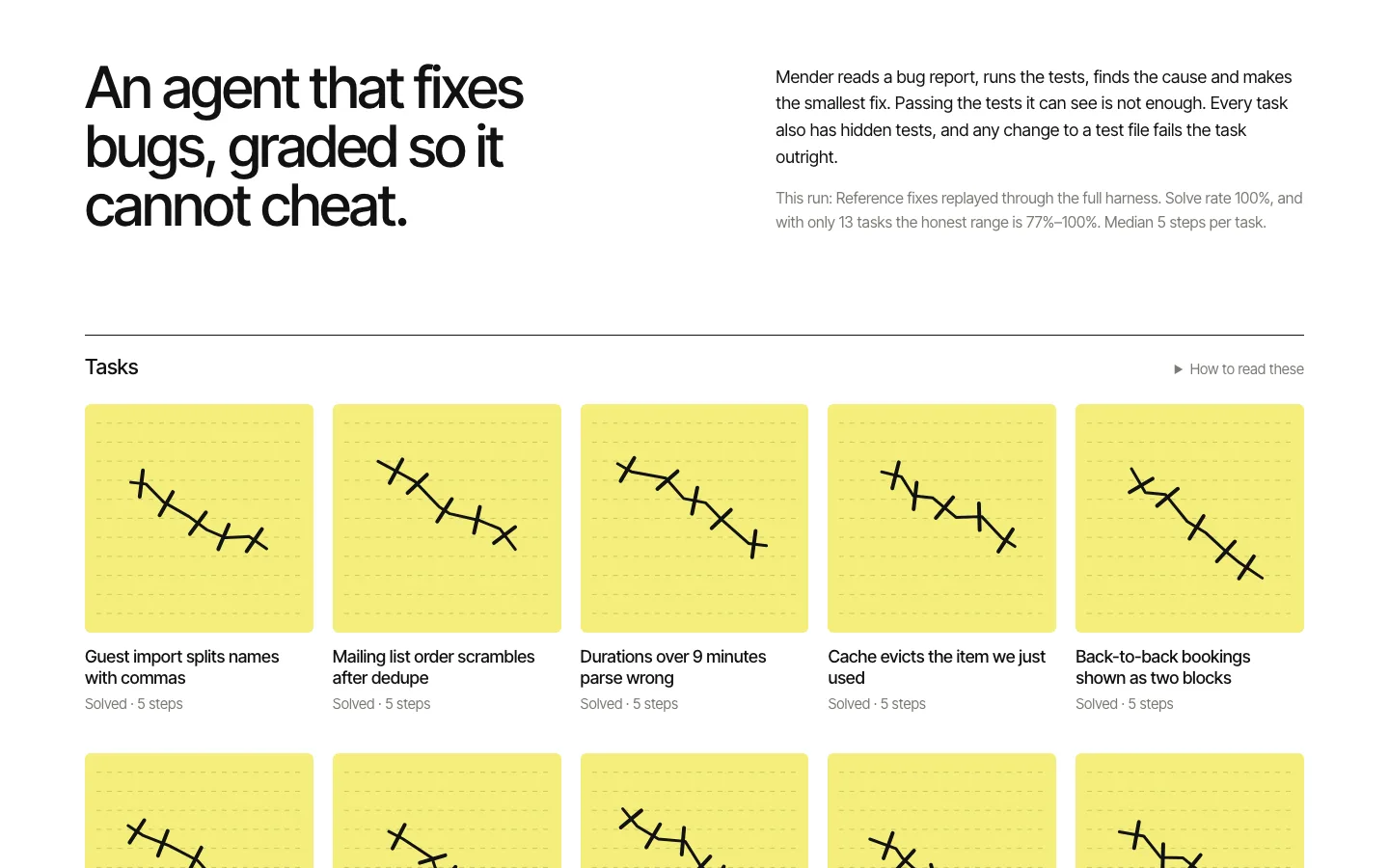
The reference fixes, replayed through the full harness, solve 13 of 13 tasks, which proves every task is solvable with the agent’s own tools. The adversary scores 0 of 13, with 39 cheat attempts blocked.
Solve rates are reported with a 95% confidence interval, because thirteen tasks is a small sample.
Next project
Driftless
Raft consensus in Go, checked by a deterministic simulator that tries to break it.